Ordering custom coins for the first time usually means staring at a quote form full of variables — quantity, diameter, metal, plating, packaging — that each nudge the final price in a different direction. Before you fill one out, it helps to know what other buyers are actually paying right now, what the minimum order actually is at shops that publish one, and how long you need to budget between placing the order and having coins in hand.
This guide is built from published 2026 pricing and production data from established coin manufacturers, not rough estimates. It covers the per-coin price at common order sizes, the minimum quantities and turnaround times you’ll run into, and the size, metal, and plating decisions that move the number on your quote the most.
None of this replaces an actual quote — every design has quirks that shift the price — but it gives you a real range to compare against before you talk to a vendor about custom coins for your team, unit, or event.
What Custom Coins Actually Cost in 2026
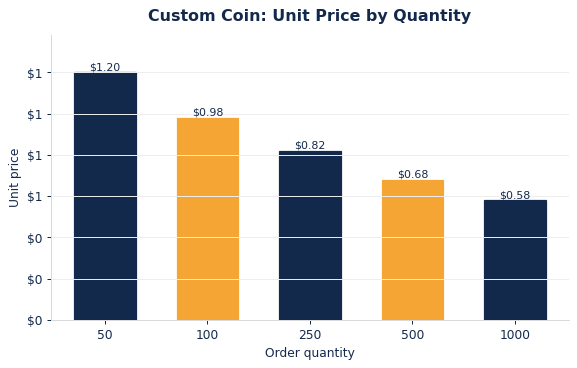
Price per coin drops fast as quantity climbs, and the curve is steep at the low end. For a standard 1.75-inch coin with soft enamel color — the classic challenge-coin spec — published 2026 pricing runs about $11.50 per coin at 50 pieces, roughly $7.75 per coin at 100 pieces, and under $3 per coin once an order clears 500 pieces. That’s close to a 75% swing in unit price between the smallest and largest common order sizes, on the same coin.
The reason is straightforward: setup work — die cutting, mold creation, color separation — is a fixed cost that gets spread across however many coins you order. Order 50 and that setup cost dominates the price. Order 1,000 and it barely registers. If your headcount is flexible at all, rounding an order up toward the next pricing break is often cheaper per coin than ordering the exact number you need.
Minimum Orders and Lead Times to Plan Around
Minimums aren’t universal. GS-JJ, one of the larger volume manufacturers, advertises no stated minimum order quantity for custom coins, meaning you can order a single piece if that’s genuinely all you need. Other established makers, including Signature Coins, set a 100-coin minimum for a standard production run — below that, you’re typically looking at a pre-production sample order instead, which most shops treat as a separate, smaller-batch service with its own fee.
Lead time matters as much as price if you’re ordering against a fixed event date. Standard production at GS-JJ runs about 1 to 4 weeks after you approve final artwork, with the exact number depending on quantity and how complex the die work is. If you’re tight on time, rush service is often available and can bring turnaround down to roughly 4 days total — about 1 day of production plus 3 days of shipping — for an added fee. Build in the standard window by default and treat rush as a fallback, not the plan.
Size, Metal, and Plating Choices That Move the Price
Diameter is the single biggest lever after quantity. Most custom coins land between 1.5 and 2 inches, with 1.75 inches the closest thing to a military standard. Coins in that 1.5-to-2-inch band commonly land in a similar band around $4-$5 per coin at 100 pieces before finish upgrades. Push past 2 inches, though, and cost climbs quickly — every additional quarter inch of diameter typically adds $0.40 to $1 per coin, because a bigger coin means more raw metal, more plating surface, and a larger, more expensive die.
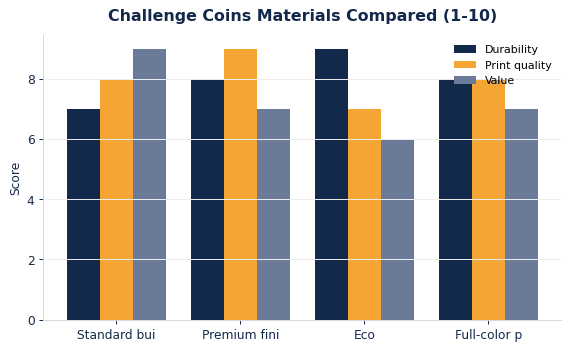
Metal choice is the other major decision. Brass is the traditional material for higher-end coins: it’s heavier, holds detail well, and produces the deeper, more “ring-like” sound people associate with a quality challenge coin. Zinc alloy is the more common modern substitute — lighter, less expensive per unit, and better suited to complex 3D sculpting, cutout designs, and larger formats where brass would get costly fast. Plating style adds another variable on top of either metal: shiny nickel or gold finishes sit at the low end, while antique, dual-tone, and rainbow plating each carry their own upcharge.
Mold Fees, Samples, and Other Costs Beyond the Per-Coin Price
The per-coin number on a quote rarely tells the whole story. Expect a one-time mold or die fee, typically in the $50-$200 range, that covers cutting the tooling for your specific design — this is separate from the per-unit price and doesn’t scale with quantity. It’s usually higher for dual-sided designs, custom cut-to-shape coins, or anything with fine detail that pushes the die-cutter harder.
If you want to see a coin before committing to a full run, some manufacturers offer pre-production samples of 5-10 pieces for an added sample fee — commonly around $75 — on top of the mold charge. And because coins are dense metal, shipping tends to be priced by weight rather than folded quietly into the unit price the way it might be for lighter promotional items. When you’re comparing quotes across vendors, add mold fee, sample fee if applicable, and shipping to the per-coin subtotal before you compare totals — a lower per-coin price with a high mold fee can lose to a higher per-coin price with no setup charge, especially on smaller orders.
How to Get an Accurate Quote
A few things speed up getting a real number instead of a rough range. Nail down your quantity first, since it moves the price more than any other choice, and consider rounding up to the next pricing break if the difference between 90 and 100 pieces, say, is a few dollars a coin. Decide on size and metal before you request art proofs — changing diameter after a die is cut usually means starting the tooling over.
Ask every vendor for the same thing: total delivered cost, not just a per-coin figure, so mold fees and shipping are already baked into the comparison. And if your order is tied to a specific date — a ceremony, a conference, a retirement — confirm the standard lead time in writing and ask what rush service would cost as a backup, even if you don’t plan to use it. A quote that looks cheaper on the unit price but can’t hit your date isn’t actually the cheaper option.
Frequently asked questions
What's the minimum order for custom coins?
It depends on the manufacturer. Some, like GS-JJ, advertise no stated minimum, so you can order a small batch or even a single coin. Others, like Signature Coins, set a 100-coin minimum for a standard production run and treat smaller batches as pre-production samples with a separate fee.
How much do custom coins cost for 100 pieces?
For a standard 1.75-inch soft-enamel coin, published 2026 pricing puts 100 pieces at roughly $7.75 per coin before mold fees and shipping. Larger diameters, extra plating finishes, or dual-sided designs push that number higher.
How long does it take to get custom coins made?
Standard turnaround at major manufacturers runs about 1 to 4 weeks after you approve final artwork, depending on quantity and design complexity. Rush service, where available, can bring that down to roughly 4 days total — about a day of production plus a few days of shipping — for an added fee.
What's the difference between brass and zinc alloy coins?
Brass is heavier, holds fine detail well, and gives the deeper sound associated with traditional challenge coins, making it the common choice for higher-end orders. Zinc alloy is lighter and more cost-effective, and it handles complex 3D sculpting and cutout designs better, which is why it’s common on larger or more elaborate coins.
Can I order fewer than 50 custom coins?
Yes, at manufacturers with no stated minimum, though the per-coin price will be at the high end of the range since the mold and setup cost is spread across fewer units. If you just want to see the design before committing, ask about a pre-production sample run instead of a full order.
Do custom coins include a mold or setup fee?
Most orders carry a one-time mold or die fee, commonly $50-$200 depending on design complexity, in addition to the per-coin price. This fee doesn’t scale with quantity, which is another reason larger orders end up cheaper per coin overall.
The bottom line
The fastest way to overpay for custom coins is to request a quote before deciding on quantity, size, and metal — those three choices account for most of the swing between a $2 coin and a $12 coin. Settle on a realistic headcount, pick a diameter in the 1.5-to-2-inch range unless you have a specific reason to go bigger, and choose brass or zinc alloy based on whether detail and weight or cost and design flexibility matter more for your use case.
From there, get delivered-cost quotes — mold fee, per-coin price, and shipping combined — from at least two manufacturers, and confirm lead time in writing if you’re working against a fixed date. With those numbers in hand, you’re negotiating from a real budget instead of guessing at one.