Author: George

  • Custom Coins: What They Really Cost in 2026

    Ordering custom coins for the first time usually means staring at a quote form full of variables — quantity, diameter, metal, plating, packaging — that each nudge the final price in a different direction. Before you fill one out, it helps to know what other buyers are actually paying right now, what the minimum order actually is at shops that publish one, and how long you need to budget between placing the order and having coins in hand.

    This guide is built from published 2026 pricing and production data from established coin manufacturers, not rough estimates. It covers the per-coin price at common order sizes, the minimum quantities and turnaround times you’ll run into, and the size, metal, and plating decisions that move the number on your quote the most.

    None of this replaces an actual quote — every design has quirks that shift the price — but it gives you a real range to compare against before you talk to a vendor about custom coins for your team, unit, or event.

    What Custom Coins Actually Cost in 2026

    Price per coin drops fast as quantity climbs, and the curve is steep at the low end. For a standard 1.75-inch coin with soft enamel color — the classic challenge-coin spec — published 2026 pricing runs about $11.50 per coin at 50 pieces, roughly $7.75 per coin at 100 pieces, and under $3 per coin once an order clears 500 pieces. That’s close to a 75% swing in unit price between the smallest and largest common order sizes, on the same coin.

    The reason is straightforward: setup work — die cutting, mold creation, color separation — is a fixed cost that gets spread across however many coins you order. Order 50 and that setup cost dominates the price. Order 1,000 and it barely registers. If your headcount is flexible at all, rounding an order up toward the next pricing break is often cheaper per coin than ordering the exact number you need.

    Per-coin price falls about 74% between a 50-piece order and a 500+ piece run of the same 1.75-inch soft-enamel coin.50 coins: $11.50; 100 coins: $7.75; 500+ coins: $3.0050 coins$11.50100 coins$7.75500+ coins$3.00
    Per-coin price falls about 74% between a 50-piece order and a 500+ piece run of the same 1.75-inch soft-enamel coin.Source: The Patchio, "How Much Do Challenge Coins Cost? 2026 Pricing Guide" (thepatchio.com, 2026)

    Minimum Orders and Lead Times to Plan Around

    Minimums aren’t universal. GS-JJ, one of the larger volume manufacturers, advertises no stated minimum order quantity for custom coins, meaning you can order a single piece if that’s genuinely all you need. Other established makers, including Signature Coins, set a 100-coin minimum for a standard production run — below that, you’re typically looking at a pre-production sample order instead, which most shops treat as a separate, smaller-batch service with its own fee.

    Lead time matters as much as price if you’re ordering against a fixed event date. Standard production at GS-JJ runs about 1 to 4 weeks after you approve final artwork, with the exact number depending on quantity and how complex the die work is. If you’re tight on time, rush service is often available and can bring turnaround down to roughly 4 days total — about 1 day of production plus 3 days of shipping — for an added fee. Build in the standard window by default and treat rush as a fallback, not the plan.

    Size, Metal, and Plating Choices That Move the Price

    Diameter is the single biggest lever after quantity. Most custom coins land between 1.5 and 2 inches, with 1.75 inches the closest thing to a military standard. Coins in that 1.5-to-2-inch band commonly land in a similar band around $4-$5 per coin at 100 pieces before finish upgrades. Push past 2 inches, though, and cost climbs quickly — every additional quarter inch of diameter typically adds $0.40 to $1 per coin, because a bigger coin means more raw metal, more plating surface, and a larger, more expensive die.

    Metal choice is the other major decision. Brass is the traditional material for higher-end coins: it’s heavier, holds detail well, and produces the deeper, more “ring-like” sound people associate with a quality challenge coin. Zinc alloy is the more common modern substitute — lighter, less expensive per unit, and better suited to complex 3D sculpting, cutout designs, and larger formats where brass would get costly fast. Plating style adds another variable on top of either metal: shiny nickel or gold finishes sit at the low end, while antique, dual-tone, and rainbow plating each carry their own upcharge.

    Mold Fees, Samples, and Other Costs Beyond the Per-Coin Price

    The per-coin number on a quote rarely tells the whole story. Expect a one-time mold or die fee, typically in the $50-$200 range, that covers cutting the tooling for your specific design — this is separate from the per-unit price and doesn’t scale with quantity. It’s usually higher for dual-sided designs, custom cut-to-shape coins, or anything with fine detail that pushes the die-cutter harder.

    If you want to see a coin before committing to a full run, some manufacturers offer pre-production samples of 5-10 pieces for an added sample fee — commonly around $75 — on top of the mold charge. And because coins are dense metal, shipping tends to be priced by weight rather than folded quietly into the unit price the way it might be for lighter promotional items. When you’re comparing quotes across vendors, add mold fee, sample fee if applicable, and shipping to the per-coin subtotal before you compare totals — a lower per-coin price with a high mold fee can lose to a higher per-coin price with no setup charge, especially on smaller orders.

    How to Get an Accurate Quote

    A few things speed up getting a real number instead of a rough range. Nail down your quantity first, since it moves the price more than any other choice, and consider rounding up to the next pricing break if the difference between 90 and 100 pieces, say, is a few dollars a coin. Decide on size and metal before you request art proofs — changing diameter after a die is cut usually means starting the tooling over.

    Ask every vendor for the same thing: total delivered cost, not just a per-coin figure, so mold fees and shipping are already baked into the comparison. And if your order is tied to a specific date — a ceremony, a conference, a retirement — confirm the standard lead time in writing and ask what rush service would cost as a backup, even if you don’t plan to use it. A quote that looks cheaper on the unit price but can’t hit your date isn’t actually the cheaper option.

    Frequently asked questions

    What's the minimum order for custom coins?

    It depends on the manufacturer. Some, like GS-JJ, advertise no stated minimum, so you can order a small batch or even a single coin. Others, like Signature Coins, set a 100-coin minimum for a standard production run and treat smaller batches as pre-production samples with a separate fee.

    How much do custom coins cost for 100 pieces?

    For a standard 1.75-inch soft-enamel coin, published 2026 pricing puts 100 pieces at roughly $7.75 per coin before mold fees and shipping. Larger diameters, extra plating finishes, or dual-sided designs push that number higher.

    How long does it take to get custom coins made?

    Standard turnaround at major manufacturers runs about 1 to 4 weeks after you approve final artwork, depending on quantity and design complexity. Rush service, where available, can bring that down to roughly 4 days total — about a day of production plus a few days of shipping — for an added fee.

    What's the difference between brass and zinc alloy coins?

    Brass is heavier, holds fine detail well, and gives the deeper sound associated with traditional challenge coins, making it the common choice for higher-end orders. Zinc alloy is lighter and more cost-effective, and it handles complex 3D sculpting and cutout designs better, which is why it’s common on larger or more elaborate coins.

    Can I order fewer than 50 custom coins?

    Yes, at manufacturers with no stated minimum, though the per-coin price will be at the high end of the range since the mold and setup cost is spread across fewer units. If you just want to see the design before committing, ask about a pre-production sample run instead of a full order.

    Do custom coins include a mold or setup fee?

    Most orders carry a one-time mold or die fee, commonly $50-$200 depending on design complexity, in addition to the per-coin price. This fee doesn’t scale with quantity, which is another reason larger orders end up cheaper per coin overall.

    The bottom line

    The fastest way to overpay for custom coins is to request a quote before deciding on quantity, size, and metal — those three choices account for most of the swing between a $2 coin and a $12 coin. Settle on a realistic headcount, pick a diameter in the 1.5-to-2-inch range unless you have a specific reason to go bigger, and choose brass or zinc alloy based on whether detail and weight or cost and design flexibility matter more for your use case.

    From there, get delivered-cost quotes — mold fee, per-coin price, and shipping combined — from at least two manufacturers, and confirm lead time in writing if you’re working against a fixed date. With those numbers in hand, you’re negotiating from a real budget instead of guessing at one.
  • Which Custom Coin Type Is Right for You? 2D, 3D, Die-Struck, and Die-Cast

    Which Custom Coin Type Is Right for You? 2D, 3D, Die-Struck, and Die-Cast

    By the time most buyers reach a coin supplier they have already decided on the fun part, the artwork, and are surprised to find the next questions are about manufacturing. Is it 2D or 3D? Die-struck or die-cast? Those are not upsells; they are the choices that decide whether your design comes out crisp, whether you can add color, how heavy the coin feels, and what a run actually costs. The good news is that the right answer usually falls out of two things you already know: what your art looks like and how many coins you need. Here is how to read those two facts into a spec.

    2D or 3D: let the artwork decide

    The 2D versus 3D question is really about depth. A 2D coin has essentially two levels, a flat background and a raised line or surface on the same plane, giving clean, legible detail that suits logos, text, monuments, and symmetrical emblems. Because those flat recessed areas act like little wells, 2D designs take enamel color easily, which is why most colorful unit and company coins are built this way. A 3D coin is sculpted, with metal rising and falling across multiple graduated levels to mimic a real object. That dimensional relief is what makes a face, an animal, a statue, or a piece of terrain look lifelike rather than flat. The trade-off is color: because a sculpted surface has no flat wells to hold liquid enamel, the 3D areas themselves usually stay bare metal, with color reserved for the flatter surrounding regions if used at all. A simple test: if your design is a crest, wordmark, or badge, 2D will render it sharply; if it is a portrait or a creature that needs to look like it has muscle and shadow, 3D is worth the sculpting.

    Die-struck or die-cast: how the coin is formed

    Relief style and forming method are related but separate decisions. Die-struck coins are made by pressing hardened steel dies into a metal blank under enormous force, on the order of several hundred to a thousand tons. That compression packs the metal tightly, producing crisp edges, a dense feel, and the traditional look prized for military and government coins. Die-struck work uses metals like bronze, brass, and iron, and bronze in particular resists corrosion and takes plating well. Its limitation is depth: struck relief is comparatively shallow, on the order of a millimeter and a half at most, and cutouts or irregular outlines require extra secondary dies.

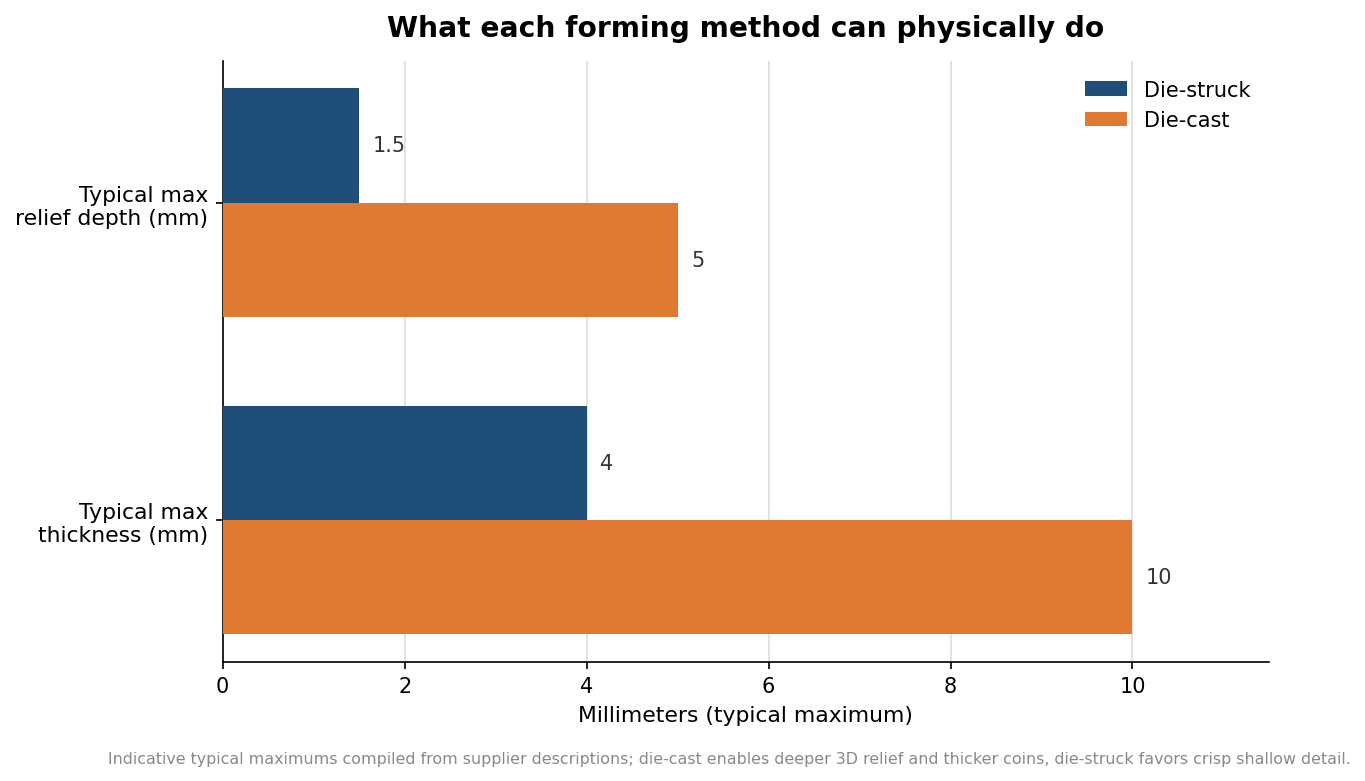
    Die-cast coins are made by injecting molten zinc alloy into a mold, which lets the metal flow into deep, complex geometry that striking cannot reach. That is what enables full sculptural 3D, thicker coins, and cutouts or unusual shapes formed right in the mold. Zinc alloy will not rust, though it is softer than bronze. The chart below sums up the physical gap: die-cast can hold several millimeters of relief and much greater thickness, while die-struck stays shallow but sharp.

    Horizontal grouped bar chart comparing typical maximum relief depth and thickness in millimeters for die-struck and die-cast coins
    Die-cast reaches deeper 3D relief and greater thickness; die-struck stays shallow but crisp.

    In practice the two decisions pair up naturally. A flat 2D emblem with lots of enamel is a classic die-struck coin. A deeply sculpted 3D mascot or a coin cut into a custom silhouette usually points to die-cast. The finer detail thresholds are close enough that artwork, not line width, is what should drive the call.

    Where enamel and printing fit in

    Color is a layer on top of the forming choice rather than a separate coin type. Soft enamel, which sits recessed below the metal ridges for a textured feel, and hard enamel, which is polished flush and smooth, both work best over the flat wells of a struck or 2D design; the difference between them is worth its own discussion, and this site covers it in a dedicated guide. For artwork that no metal-and-enamel process can reproduce, such as a photograph, a gradient sky, or fine multicolor illustration, offset or printed coins reproduce the image in full color and seal it under a clear protective dome. Printed coins trade the tactile, heirloom quality of struck metal for photographic fidelity, so they suit event and commemorative pieces where the picture is the point more than the heft.

    Match the method to your run size

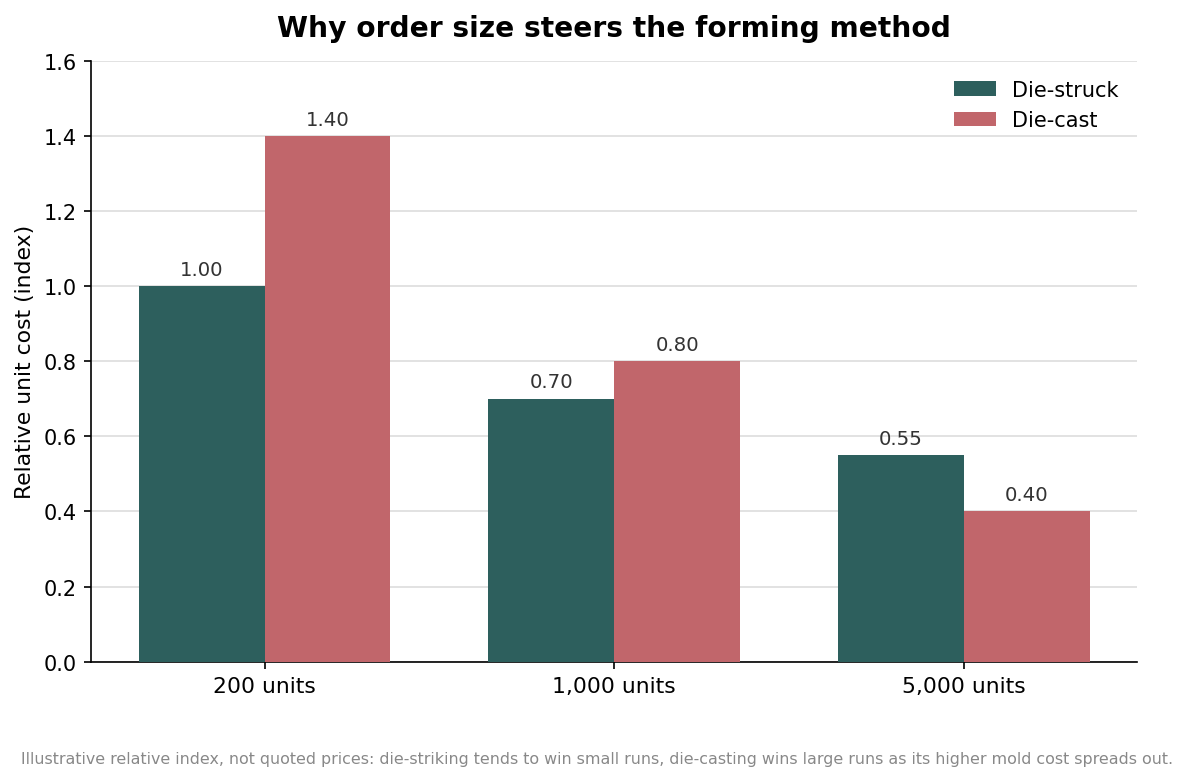
    Once artwork has narrowed the field, order quantity often settles it, because the two methods have very different cost shapes. Die-cast molds cost meaningfully more to make than die-struck dies, so at small quantities, roughly the low hundreds, die-striking is usually the more economical route. As volume climbs into the thousands, casting’s automated, high-throughput process spreads that mold cost thin and its per-unit price drops below struck coins. The illustrative index below shows the pattern rather than any quoted price: struck leads on small runs, the two converge in the middle, and cast pulls ahead on large runs.

    Grouped bar chart of illustrative relative unit cost for die-struck versus die-cast coins at 200, 1,000, and 5,000 units
    An illustrative view of the cost crossover: die-struck wins small runs, die-cast wins large runs.

    Use case tends to reinforce whatever the numbers suggest. A unit ordering a few hundred collectible coins with a sharp 2D crest is squarely in die-struck territory, and the traditional weight is part of the appeal. A company producing several thousand giveaway coins with a sculpted character, or a coin shaped like its product, will likely land on die-cast and be glad of the lower unit cost. When your run size and your artwork point at different methods, artwork should win for anything where the coin’s look is the whole reason it exists, and cost should win when the coins are functional handouts. Sort out these two questions, relief and forming method, before you fuss over plating and packaging, because they set the frame that every later choice fits inside.

  • What a Custom Challenge Coin Really Costs — and What Drives the Price

    What a Custom Challenge Coin Really Costs — and What Drives the Price

    The honest answer to “what does a custom challenge coin cost” is that it depends on four things: how many you order, how big the coin is, how it is finished, and what extras you add. Once you see how those levers work together, a quote stops looking like a mystery and starts looking like a set of choices you control. Here is how the price of a coin actually adds up, with indicative 2026 ranges you can plan against before you ask for a formal quote.

    First the one-time die fee, then the per-coin price

    Every custom coin carries two separate costs. The first is a one-time die or mold fee to cut the tooling that stamps your design. For a standard two-dimensional coin that fee commonly runs somewhere around $50 to $200, and it climbs toward $300 or more for a sculpted three-dimensional die. The important part is that it is charged once: an exact reorder from the same die usually skips it entirely. The second cost is the per-coin price, which covers the metal, the enamel, the plating, and the labor for each piece. On a small run the fixed die fee dominates and makes each coin look expensive; on a large run it disappears into the background. That single dynamic explains why quantity matters more than almost anything else.

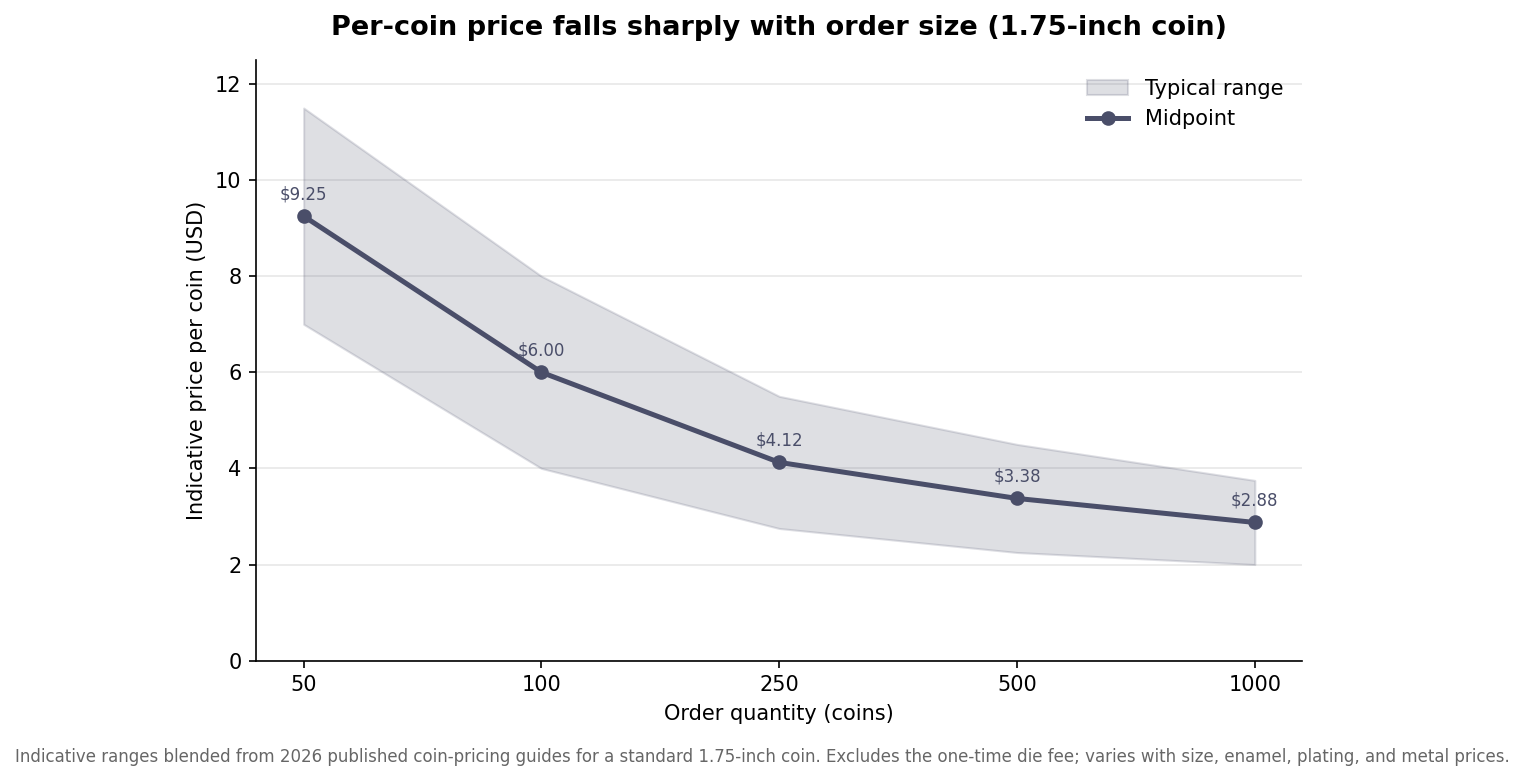
    Line chart with shaded range band showing indicative per-coin challenge coin price falling from about 9 dollars at 50 coins to under 4 dollars at 1000 coins
    Indicative per-coin price for a 1.75-inch coin drops fastest at low quantities, then flattens.

    Quantity is the biggest lever you have

    Per-coin pricing drops steeply as the order grows. For a standard 1.75-inch coin, indicative figures land near seven to eleven dollars each at 50 pieces, fall to roughly four to eight dollars at 100, and settle around two to just under four dollars each at 1,000. The curve is steepest at the low end, where spreading the die fee and setup across more coins produces the fastest savings, then flattens once you pass a few hundred. The practical takeaway is to order for the whole year rather than in small repeat batches: two runs of 100 will almost always cost more per coin, and more in total die and setup charges, than a single run of 250. If you are close to a price break, nudging the quantity up often lowers your per-coin cost enough to nearly pay for the extra pieces.

    Size, enamel, and plating set the base price

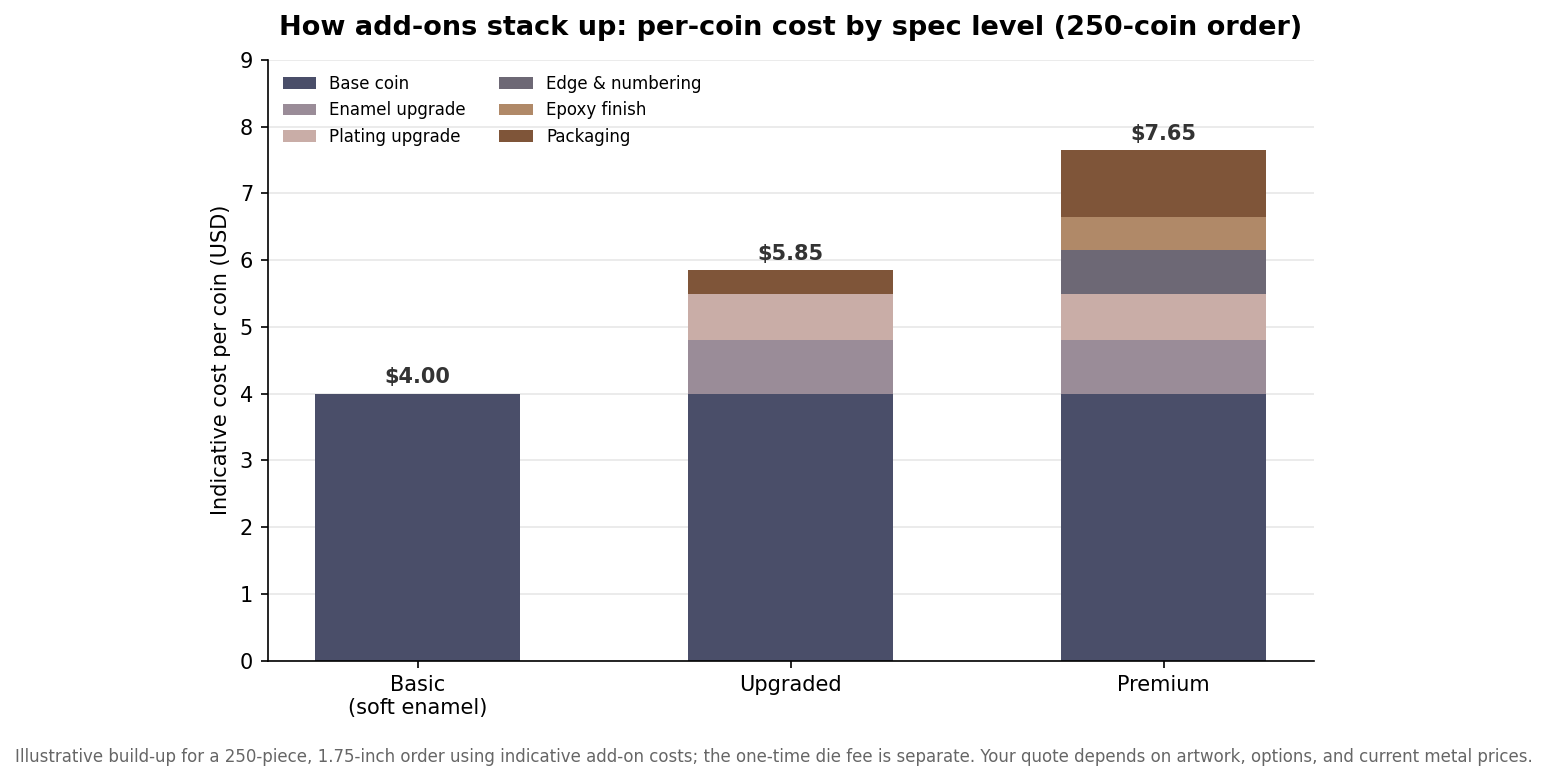
    Within a given quantity, three choices set the baseline. Size and thickness come first, because a bigger or heavier coin simply uses more metal: 1.75 inches is the common military and club standard, while a 2-inch presentation coin adds a modest premium and larger or thicker pieces add more. Enamel type is next. Soft enamel, with recessed color and raised metal lines, is the most economical finish; hard enamel, polished flat and more durable, typically adds roughly 15 to 30 percent, and offset or photographic printing lands in a similar range when your art needs gradients or fine imagery. Plating is the third: standard gold, silver, or antique finishes are included in most base prices, while dual plating that combines two metals on one coin adds around 50 cents to a dollar per piece. The base metal plays a quieter role as well: most coins are struck in a zinc alloy or brass, and the choice, along with the day’s metal prices, nudges the baseline up or down. These decisions define the coin before you add a single extra.

    The add-on menu: where coins get special, and pricier

    Beyond the base coin sits a menu of upgrades, each with its own small per-coin cost. Three-dimensional sculpting is the most significant, adding roughly a quarter to a third to the per-coin price on top of a higher die fee, because the tooling is more complex to cut. Decorative edges such as rope, reeded, or cross-cut borders run about 20 to 50 cents per coin, and sequential numbering or edge engraving adds a similar 20 to 40 cents. An epoxy dome, the clear protective coating over the face, adds around 50 cents. Cutouts and moving spinner elements require extra tooling and raise both the die fee and the per-coin cost. Specialty enamel effects such as translucent color over a textured metal base or glitter fill are usually modest per-coin additions, but they change the look enough to be worth a sample before you commit the full run. Presentation matters too: a plastic capsule runs a quarter to fifty cents, a velvet pouch about a dollar, and a rigid velvet gift box two to four dollars each. Finally, a rush order to compress the normal production window can add 20 to 50 percent to the total, so plan ahead when you can.

    Stacked bar chart showing per-coin cost building from a basic soft-enamel coin to upgraded and premium specs for a 250-coin order
    How base coin, enamel, plating, edge work, finish, and packaging stack up at three spec levels.

    How to control the final quote

    Put the levers in order of impact and the price becomes manageable. Decide the quantity first, since it moves the per-coin number more than anything else and spreads the die fee thin. Choose size and enamel for the look and durability you want, knowing hard enamel and larger coins cost more but read as more premium. Then add only the extras that earn their place — sequential numbering for a limited edition, an epoxy dome for a coin that will be handled hard, a gift box for a presentation piece — rather than checking every box on the menu. Every figure here is indicative and moves with artwork complexity and current metal prices, so treat it as a planning range and confirm with a real quote. But if you walk in knowing that quantity drives the base, finish drives the feel, and add-ons stack on top, you will read that quote as a set of decisions you made on purpose.

  • How to Choose Custom Coins for Your Brand

    How to Choose Custom Coins for Your Brand

    How to Choose Custom Coins for Your Brand: Use Cases and Ordering

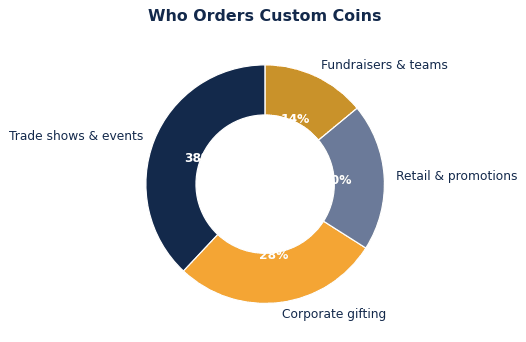
    The best way to choose custom challenge coins is to start from how they will be used, then work back to the material, size, and decoration that fit. Custom challenge coins serve very different jobs across trade shows & events, corporate gifting, retail & promotions, and fundraisers & teams, and matching the order to the job is what makes custom coins feel purpose-built rather than generic. This guide maps the common use cases and walks through ordering custom coins that fit your brand.

    Whether the challenge coins protects a product, presents a gift, or carries a logo into the world, defining that job first keeps every later decision easy. Purpose drives the spec, and the spec drives the result.

    How brands use custom coins

    Custom challenge coins get ordered for a mix of protection, presentation, and promotion, and knowing where yours fall points you to the right build. The breakdown below shows the common uses, from trade shows & events to fundraisers & teams.

    The common ways brands put custom coins to work.
    The common ways brands put custom coins to work.

    Most orders lean toward one primary job with a secondary benefit — a shipping-focused challenge coins that also brands the unboxing, or a gift-focused one that also protects. Naming your primary use keeps the order focused and the spec appropriate.

    Use case What it needs
    Trade shows & events memorable swag that gets picked up and kept
    Corporate gifting branded items clients and staff actually use
    Retail & promotions impulse items that carry a logo home
    Fundraisers & teams affordable branded pieces for a crowd

    Matching material and size to the use

    Once the use is clear, the material and size follow. A protection-first job favors a durable, well-fitted build; a presentation-first job favors a premium material and a clean print; a promotion-first job favors a cost-effective option you can order in volume. Sizing to the product with a small margin keeps the challenge coins looking intentional and performing its job.

    If a single order serves more than one use, spec to the most demanding one so the challenge coins performs everywhere. It is easier to use a slightly sturdier or more premium challenge coins across the board than to discover a bargain option falls short for your most important use case.

    Branding for the impression you want

    Decoration should reinforce the impression the use calls for. Pad printing and full-color wraps place logos vividly, with engraving or embossing for an upscale, permanent mark. For a premium or gift use, lean on finishes and restraint; for high-volume promotion, prioritize a bold, legible logo that reads at a glance and reproduces affordably at scale. Keep branding consistent with the rest of your packaging or merch so everything reads as one system.

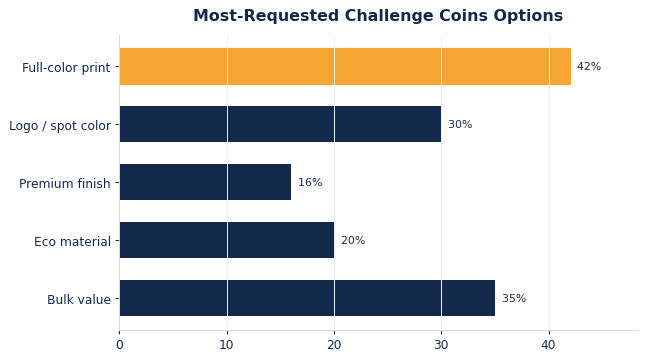
    The most-requested options below reflect what buyers reach for most, and they are a useful starting menu when you brief your order. Whatever you choose, approve a proof so the finished custom coins match the impression you intended.

    The options buyers request most on custom challenge coins.
    The options buyers request most on custom challenge coins.

    Getting the size and details right

    Even with the use and material decided, the details are what make custom coins feel finished. Confirm the size and format against the product with a small margin, check the print area for your chosen size so the logo sits cleanly, and decide on any finishing touches before you brief the order. These small confirmations up front are what separate a challenge coins that looks intentional from one that looks close-enough.

    A sample or proof is the cheapest insurance you can buy on a challenge coins order. A physical sample lets you judge the material and print in hand, while a digital proof confirms artwork, color, and size and format before the full run. Spending a few minutes here prevents the far larger cost of reworking a finished order of custom coins that missed on a detail.

    Ordering: quantities, lead time, and reorders

    A smooth challenge coins order comes down to a few basics: order for real demand plus a small overage, send print-ready artwork early, and confirm lead time against any deadline so production and shipping fit your timeline. Per-unit cost drops with volume, so consolidating a season’s needs into one run is usually more efficient than repeated small orders.

    Keep your approved artwork and spec on file so reorders are a quick repeat rather than a fresh setup each time — consistency across runs keeps your brand looking deliberate.

    Coordinating with the rest of your brand

    Custom challenge coins rarely stand alone; they sit alongside your other packaging, print, or merch, so coordinating them strengthens the whole brand. Carrying the same logo, colors, and tone across your challenge coins and your other pieces makes everything read as one deliberate system rather than a set of one-off orders. That consistency is what makes a brand feel established, and it costs nothing extra to plan.

    Coordination also simplifies buying over time. Standardizing on a material, size, and decoration you are happy with turns future orders into simple repeats, and it keeps every batch matching the last. A little upfront alignment pays back every time you reorder custom coins.

    Frequently asked questions about custom coins

    What are custom coins used for?

    Custom challenge coins serve a mix of protection, presentation, and promotion across trade shows & events, corporate gifting, retail & promotions, and fundraisers & teams. Most orders lean toward one primary job with a secondary benefit, so naming your main use is the first step in speccing the right challenge coins.

    How do I match custom coins to my use?

    Let the use drive the spec: durable and well-fitted for protection, premium and clean for presentation, cost-effective and bold for promotion. If one order serves several uses, spec to the most demanding one so the challenge coins performs everywhere.

    How should I brand custom coins?

    Pad printing and full-color wraps place logos vividly, with engraving or embossing for an upscale, permanent mark. Choose finishes and restraint for premium or gift uses, and a bold, legible logo for high-volume promotion, keeping the branding consistent with your other packaging or merch so it all reads as one system.

    How far ahead should I order custom coins?

    Order for real demand plus a small overage, send print-ready artwork early, and confirm lead time against any deadline so production and shipping fit your timeline. Consolidating a season’s needs into one run is usually more efficient than repeated small orders.

    Can I reorder easily?

    Yes. Keeping your approved artwork and spec on file makes reorders a quick repeat rather than a fresh setup, and it keeps every batch of custom coins matching the last for a consistent brand look.

    Do I need a sample before ordering custom coins?

    A sample is worth it for a first order or a new material, since judging feel and print in hand removes the guesswork. For a straightforward reorder of custom coins you have bought before, a digital proof confirming artwork and size and format is usually enough.

    Match the challenge coins to the job, spec it deliberately, and approve a proof, and your order will do exactly what you needed. For the full material and sizing breakdown, see our companion guide, our Custom Coins: Materials, Sizing & Branding Guide, and browse our our shop to get started.

    Not sure which custom coins fit your use?

    Tell us how you’ll use them and we’ll match the material, size, and branding to the job.

    Get a Quote

  • Custom Coins: Materials, Sizing & Branding Guide

    Custom Coins: Materials, Sizing & Branding Guide

    Custom Coins: A Materials, Sizing, and Branding Guide

    Getting custom coins right comes down to three decisions: the material, the size or spec, and how you brand them. Make those well and you end up with custom coins that protect and present your product, reinforce your brand, and land on budget. This guide walks through the material options, how to size and spec your order, and how to decorate custom coins so they do real work for your brand rather than just checking a box.

    Whether you are ordering your first run or reordering at scale, the same fundamentals apply. Choosing custom coins deliberately — material to job, size to product, decoration to brand — is what separates an order you are proud of from one you settle for.

    Why custom coins matter for your brand

    Custom coins are more than a commodity; they are a touchpoint brands experience directly. A well-chosen, well-branded option signals quality and attention to detail, while a generic one quietly undercuts an otherwise strong product. Because custom coins are seen and handled, they carry your brand into the world every time they are used.

    That visibility is exactly why it pays to spec custom coins intentionally. The material sets the feel, the size sets the fit and cost, and the decoration sets the impression — and getting all three aligned turns a functional item into a genuine brand asset.

    Materials and options compared

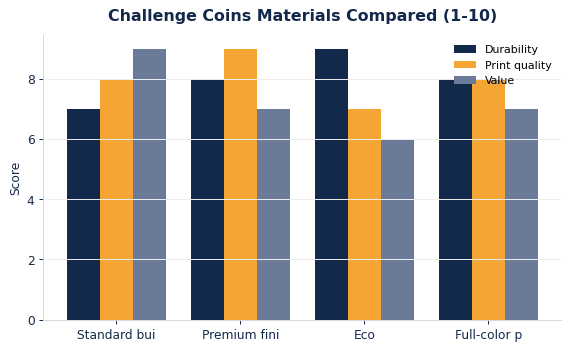
    The common materials for custom coins each trade off durability, print quality, and cost: standard build, premium finish, eco / recycled, and full-color print surface. The right pick depends on how the challenge coins will be used, the look you want, and your budget. The chart and table below compare the main options so you can match material to job.

    How common challenge coins materials compare on durability, print quality, and value.
    How common challenge coins materials compare on durability, print quality, and value.

    As a rule of thumb, choose a recyclable or natural material when eco positioning matters, a coated or laminated option when you want vivid full-color print, and a premium build when the challenge coins is part of a gift or high-end presentation. When in doubt, request a sample so you can judge feel and print before committing to a full run.

    Material / option Best for
    Standard build reliable, cost-effective for high-volume swag
    Premium finish soft-touch or upgraded feel for gifting
    Eco / recycled sustainable option that signals brand values
    Full-color print surface vivid, edge-to-edge branding area

    Sizing and specs

    Sizing is where many challenge coins orders go wrong, so measure before you order. Custom coins typically range from a compact giveaway up to a larger statement piece, and the right size and format depends on the product or use they serve. Too small and the fit is tight or the product is exposed; too large and you pay for material you do not need and lose a clean, intentional look.

    When a measurement falls between standard options, size to the product with a small margin rather than guessing. Confirming the size and format on a proof or sample before a large run prevents the costly mistake of a full order that does not fit, which is far more expensive to fix than a five-minute check up front.

    Branding and decoration

    Decoration is what turns a plain challenge coins into a branded one. Pad printing and full-color wraps place logos vividly, with engraving or embossing for an upscale, permanent mark. Match the method to your artwork and budget: simple logos reproduce cleanly and cheaply, while detailed, full-color designs shine with the right process on the right material. Keep the artwork vector where possible and confirm the print area for your chosen size.

    Restraint usually reads as premium. A clean logo, one or two brand colors, and quality material almost always look more considered than a busy, over-printed design. Approving a proof before the run protects both the look and the budget, especially on a large order of custom coins.

    Ordering and budget

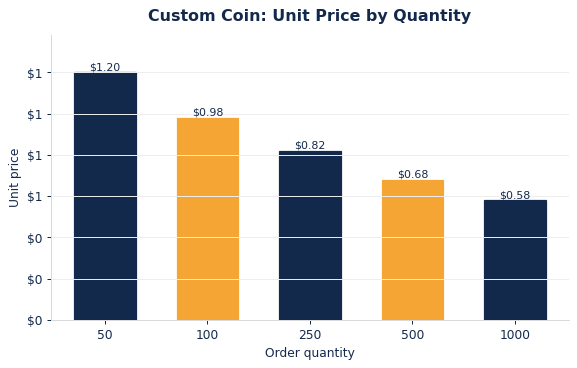
    Per-unit cost on custom coins falls steadily with volume as setup amortizes across more pieces, so ordering for real demand rather than a token first batch is usually the efficient move. The curve below shows how pricing typically improves with quantity, which helps you plan an order that balances cash and cost.

    Typical per-unit challenge coins pricing as order quantity increases.
    Typical per-unit challenge coins pricing as order quantity increases.
    Ordering for a recurring need? A single larger run lowers the unit cost and keeps your branding consistent, while a small overage covers reorders and the occasional damaged piece without a rush order.

    Common mistakes to avoid

    A few avoidable missteps account for most disappointing challenge coins orders. Ordering before measuring is the biggest, followed by choosing a material for price alone without considering how the challenge coins will actually be used, and skipping the proof on a large run. Each is easy to prevent with a few minutes of planning, and each is expensive to fix once a full order is produced.

    The other common trap is over-designing the artwork. Cramming in too many colors, effects, or details can muddy the print and raise the cost, especially on textured or recycled materials. Simplifying the design to a clean, legible mark almost always improves both the look and the price of your custom coins.

    Frequently asked questions about custom coins

    What material is best for custom coins?

    It depends on the use: choose a recyclable or natural material for eco positioning, a coated or laminated option for vivid full-color print, and a premium build for gifting or high-end presentation. Request a sample to judge feel and print before a full run of custom coins.

    How do I choose the right size?

    Measure the product or use the challenge coins serves, then size to it with a small margin so the fit is clean without wasting material. When a measurement falls between standard options, size up slightly and confirm the size and format on a proof before ordering in volume.

    How are custom coins branded?

    Pad printing and full-color wraps place logos vividly, with engraving or embossing for an upscale, permanent mark. Match the method to your artwork and budget, keep the art vector where possible, confirm the print area for your size, and approve a proof so the finished custom coins match your intent.

    How does pricing work, and is there a minimum?

    Per-unit cost drops with quantity as setup amortizes across the run, so larger orders are more cost-effective. Order for real demand plus a small overage rather than a token batch, and consolidate recurring needs into one run for the best price.

    Can I get a sample or proof before ordering?

    Yes, and it is strongly recommended. A physical sample lets you judge material and print, and a digital or physical proof confirms your artwork, color, and size and format before a full run — a small step that prevents a costly mistake on a large order.

    What do you need to quote custom coins?

    To quote accurately we need the size and format or the product they serve, the quantity, your material preference, and your artwork or a description of the branding. With those details we can recommend the right material and size and give you pricing for the run, and a proof follows once the order is confirmed.

    Whatever you order, send vector artwork, confirm material and size and format, and approve a proof before production. For help matching custom coins to a specific use, see our companion guide, our How to Choose Custom Coins for Your Brand, and explore our our shop to start your order.

    Ready to order custom coins?

    Tell us your product, quantity, and branding and we’ll match the material, size, and decoration for you.

    Get a Quote