The honest answer to “what does a custom challenge coin cost” is that it depends on four things: how many you order, how big the coin is, how it is finished, and what extras you add. Once you see how those levers work together, a quote stops looking like a mystery and starts looking like a set of choices you control. Here is how the price of a coin actually adds up, with indicative 2026 ranges you can plan against before you ask for a formal quote.
First the one-time die fee, then the per-coin price
Every custom coin carries two separate costs. The first is a one-time die or mold fee to cut the tooling that stamps your design. For a standard two-dimensional coin that fee commonly runs somewhere around $50 to $200, and it climbs toward $300 or more for a sculpted three-dimensional die. The important part is that it is charged once: an exact reorder from the same die usually skips it entirely. The second cost is the per-coin price, which covers the metal, the enamel, the plating, and the labor for each piece. On a small run the fixed die fee dominates and makes each coin look expensive; on a large run it disappears into the background. That single dynamic explains why quantity matters more than almost anything else.
Quantity is the biggest lever you have
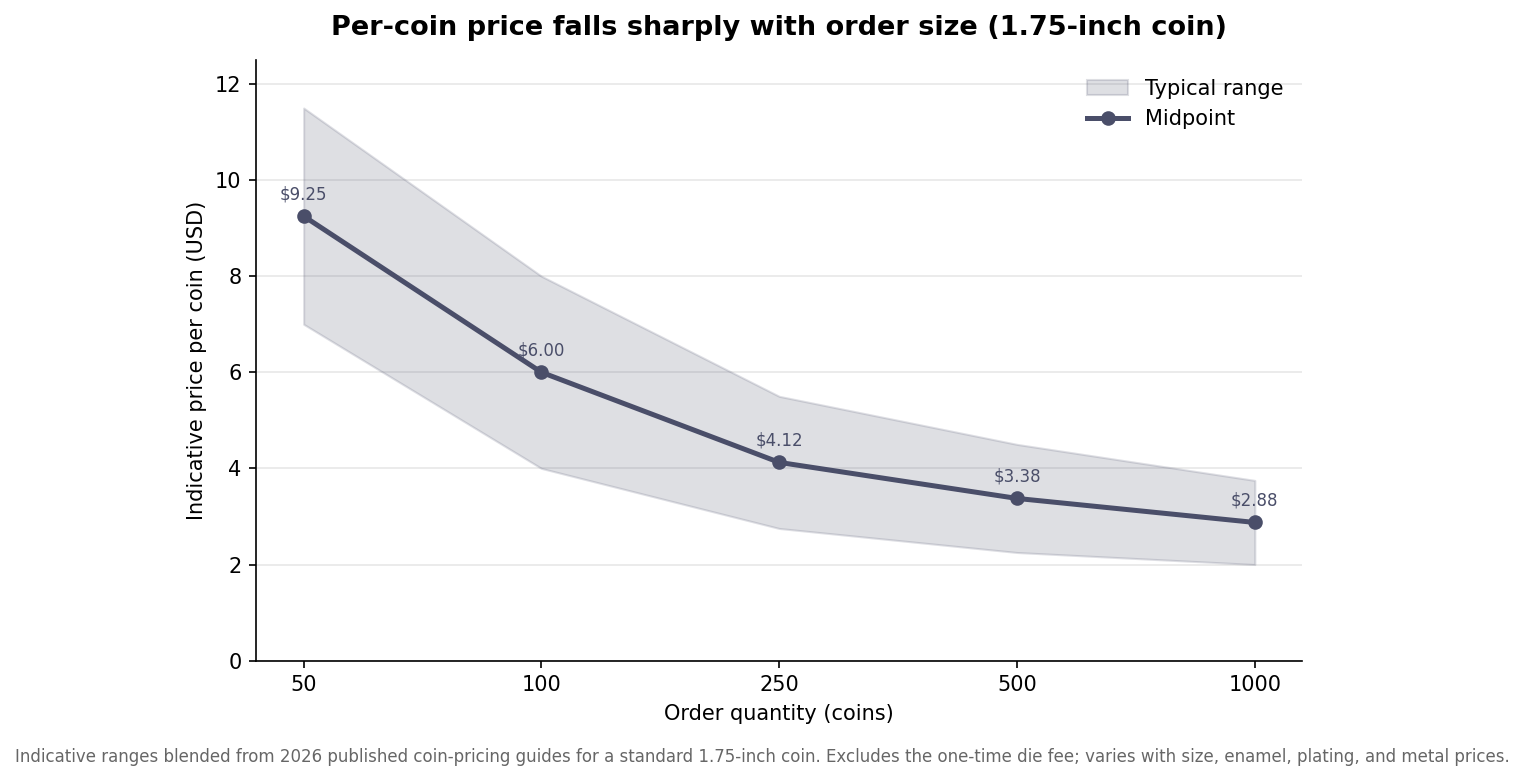
Per-coin pricing drops steeply as the order grows. For a standard 1.75-inch coin, indicative figures land near seven to eleven dollars each at 50 pieces, fall to roughly four to eight dollars at 100, and settle around two to just under four dollars each at 1,000. The curve is steepest at the low end, where spreading the die fee and setup across more coins produces the fastest savings, then flattens once you pass a few hundred. The practical takeaway is to order for the whole year rather than in small repeat batches: two runs of 100 will almost always cost more per coin, and more in total die and setup charges, than a single run of 250. If you are close to a price break, nudging the quantity up often lowers your per-coin cost enough to nearly pay for the extra pieces.
Size, enamel, and plating set the base price
Within a given quantity, three choices set the baseline. Size and thickness come first, because a bigger or heavier coin simply uses more metal: 1.75 inches is the common military and club standard, while a 2-inch presentation coin adds a modest premium and larger or thicker pieces add more. Enamel type is next. Soft enamel, with recessed color and raised metal lines, is the most economical finish; hard enamel, polished flat and more durable, typically adds roughly 15 to 30 percent, and offset or photographic printing lands in a similar range when your art needs gradients or fine imagery. Plating is the third: standard gold, silver, or antique finishes are included in most base prices, while dual plating that combines two metals on one coin adds around 50 cents to a dollar per piece. The base metal plays a quieter role as well: most coins are struck in a zinc alloy or brass, and the choice, along with the day’s metal prices, nudges the baseline up or down. These decisions define the coin before you add a single extra.
The add-on menu: where coins get special, and pricier
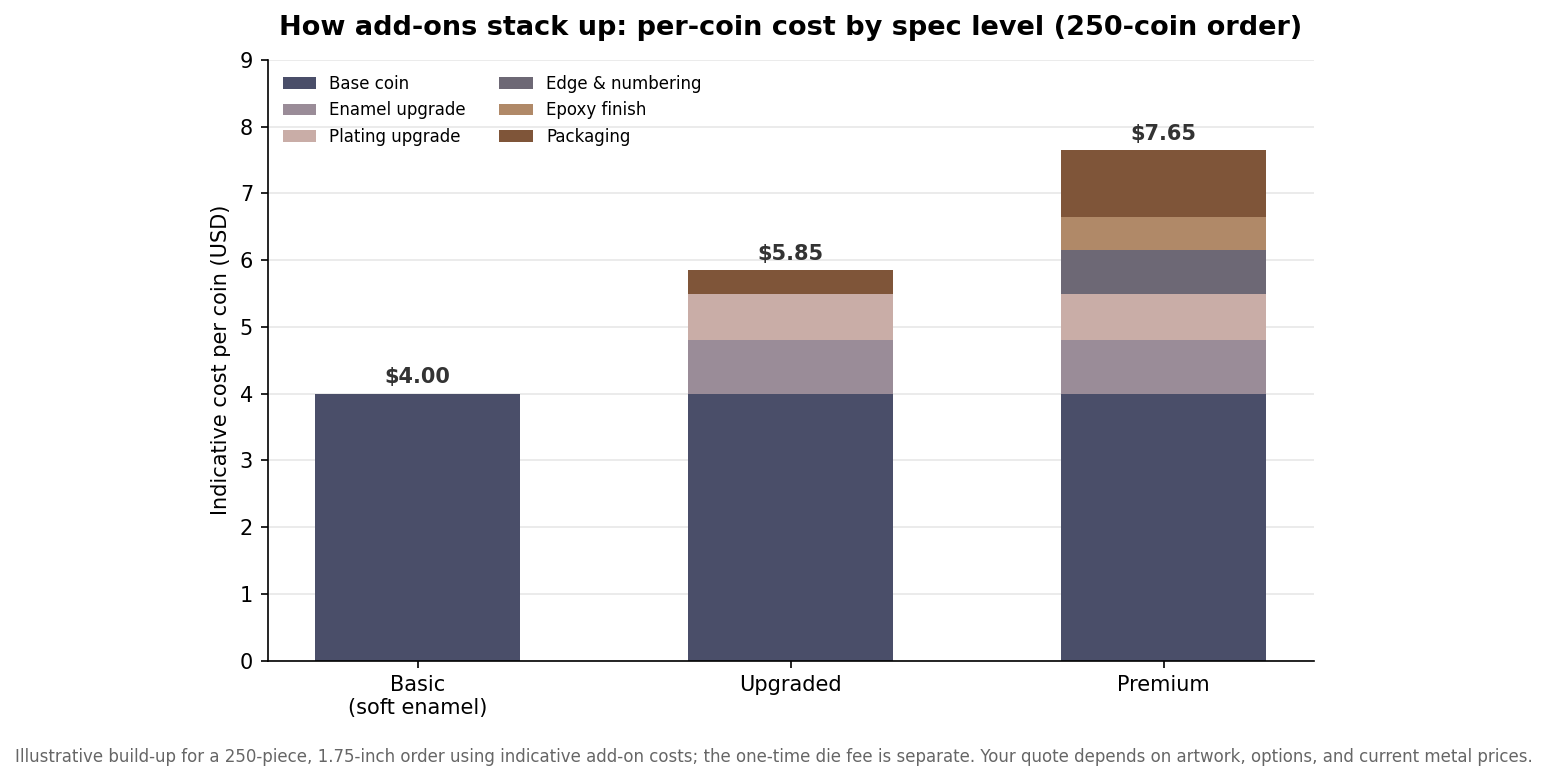
Beyond the base coin sits a menu of upgrades, each with its own small per-coin cost. Three-dimensional sculpting is the most significant, adding roughly a quarter to a third to the per-coin price on top of a higher die fee, because the tooling is more complex to cut. Decorative edges such as rope, reeded, or cross-cut borders run about 20 to 50 cents per coin, and sequential numbering or edge engraving adds a similar 20 to 40 cents. An epoxy dome, the clear protective coating over the face, adds around 50 cents. Cutouts and moving spinner elements require extra tooling and raise both the die fee and the per-coin cost. Specialty enamel effects such as translucent color over a textured metal base or glitter fill are usually modest per-coin additions, but they change the look enough to be worth a sample before you commit the full run. Presentation matters too: a plastic capsule runs a quarter to fifty cents, a velvet pouch about a dollar, and a rigid velvet gift box two to four dollars each. Finally, a rush order to compress the normal production window can add 20 to 50 percent to the total, so plan ahead when you can.
How to control the final quote
Put the levers in order of impact and the price becomes manageable. Decide the quantity first, since it moves the per-coin number more than anything else and spreads the die fee thin. Choose size and enamel for the look and durability you want, knowing hard enamel and larger coins cost more but read as more premium. Then add only the extras that earn their place — sequential numbering for a limited edition, an epoxy dome for a coin that will be handled hard, a gift box for a presentation piece — rather than checking every box on the menu. Every figure here is indicative and moves with artwork complexity and current metal prices, so treat it as a planning range and confirm with a real quote. But if you walk in knowing that quantity drives the base, finish drives the feel, and add-ons stack on top, you will read that quote as a set of decisions you made on purpose.
Leave a Reply