By the time most buyers reach a coin supplier they have already decided on the fun part, the artwork, and are surprised to find the next questions are about manufacturing. Is it 2D or 3D? Die-struck or die-cast? Those are not upsells; they are the choices that decide whether your design comes out crisp, whether you can add color, how heavy the coin feels, and what a run actually costs. The good news is that the right answer usually falls out of two things you already know: what your art looks like and how many coins you need. Here is how to read those two facts into a spec.
2D or 3D: let the artwork decide
The 2D versus 3D question is really about depth. A 2D coin has essentially two levels, a flat background and a raised line or surface on the same plane, giving clean, legible detail that suits logos, text, monuments, and symmetrical emblems. Because those flat recessed areas act like little wells, 2D designs take enamel color easily, which is why most colorful unit and company coins are built this way. A 3D coin is sculpted, with metal rising and falling across multiple graduated levels to mimic a real object. That dimensional relief is what makes a face, an animal, a statue, or a piece of terrain look lifelike rather than flat. The trade-off is color: because a sculpted surface has no flat wells to hold liquid enamel, the 3D areas themselves usually stay bare metal, with color reserved for the flatter surrounding regions if used at all. A simple test: if your design is a crest, wordmark, or badge, 2D will render it sharply; if it is a portrait or a creature that needs to look like it has muscle and shadow, 3D is worth the sculpting.
Die-struck or die-cast: how the coin is formed
Relief style and forming method are related but separate decisions. Die-struck coins are made by pressing hardened steel dies into a metal blank under enormous force, on the order of several hundred to a thousand tons. That compression packs the metal tightly, producing crisp edges, a dense feel, and the traditional look prized for military and government coins. Die-struck work uses metals like bronze, brass, and iron, and bronze in particular resists corrosion and takes plating well. Its limitation is depth: struck relief is comparatively shallow, on the order of a millimeter and a half at most, and cutouts or irregular outlines require extra secondary dies.
Die-cast coins are made by injecting molten zinc alloy into a mold, which lets the metal flow into deep, complex geometry that striking cannot reach. That is what enables full sculptural 3D, thicker coins, and cutouts or unusual shapes formed right in the mold. Zinc alloy will not rust, though it is softer than bronze. The chart below sums up the physical gap: die-cast can hold several millimeters of relief and much greater thickness, while die-struck stays shallow but sharp.
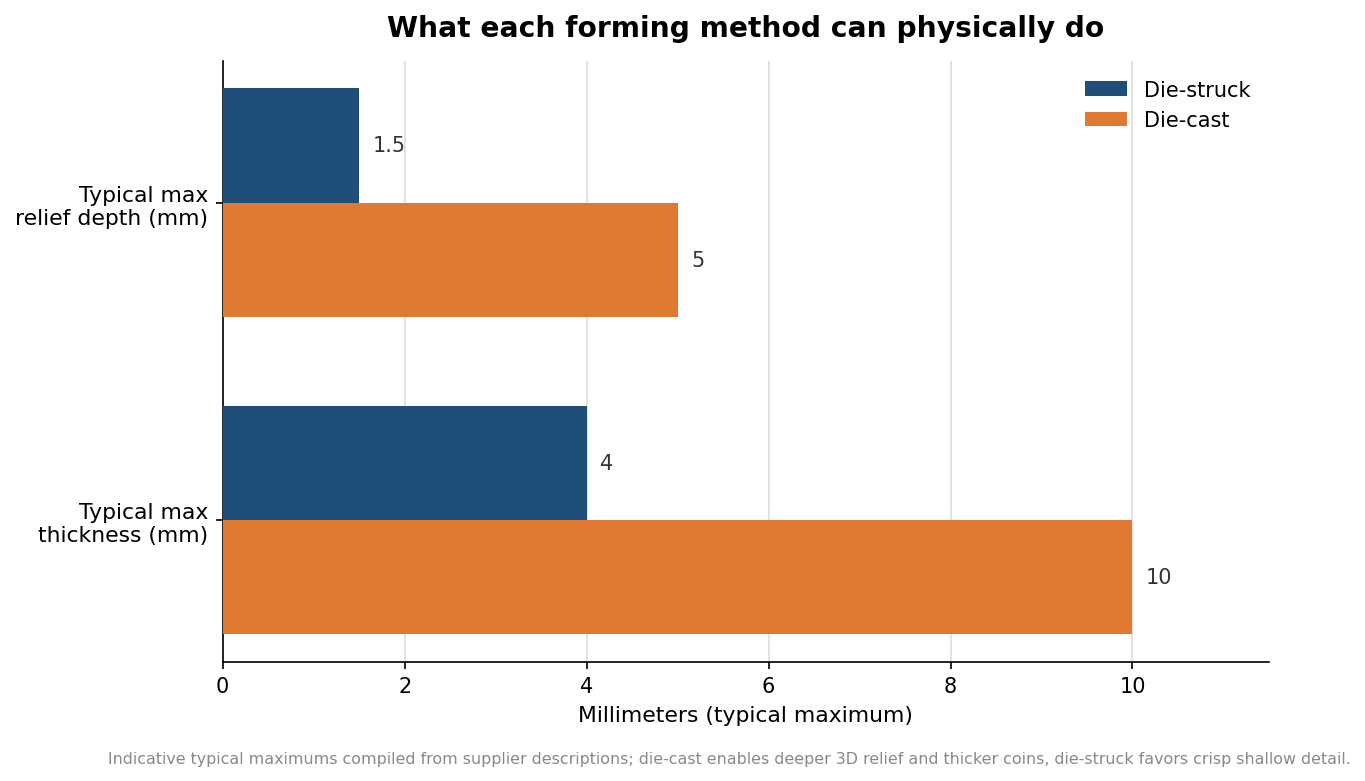
In practice the two decisions pair up naturally. A flat 2D emblem with lots of enamel is a classic die-struck coin. A deeply sculpted 3D mascot or a coin cut into a custom silhouette usually points to die-cast. The finer detail thresholds are close enough that artwork, not line width, is what should drive the call.
Where enamel and printing fit in
Color is a layer on top of the forming choice rather than a separate coin type. Soft enamel, which sits recessed below the metal ridges for a textured feel, and hard enamel, which is polished flush and smooth, both work best over the flat wells of a struck or 2D design; the difference between them is worth its own discussion, and this site covers it in a dedicated guide. For artwork that no metal-and-enamel process can reproduce, such as a photograph, a gradient sky, or fine multicolor illustration, offset or printed coins reproduce the image in full color and seal it under a clear protective dome. Printed coins trade the tactile, heirloom quality of struck metal for photographic fidelity, so they suit event and commemorative pieces where the picture is the point more than the heft.
Match the method to your run size
Once artwork has narrowed the field, order quantity often settles it, because the two methods have very different cost shapes. Die-cast molds cost meaningfully more to make than die-struck dies, so at small quantities, roughly the low hundreds, die-striking is usually the more economical route. As volume climbs into the thousands, casting’s automated, high-throughput process spreads that mold cost thin and its per-unit price drops below struck coins. The illustrative index below shows the pattern rather than any quoted price: struck leads on small runs, the two converge in the middle, and cast pulls ahead on large runs.
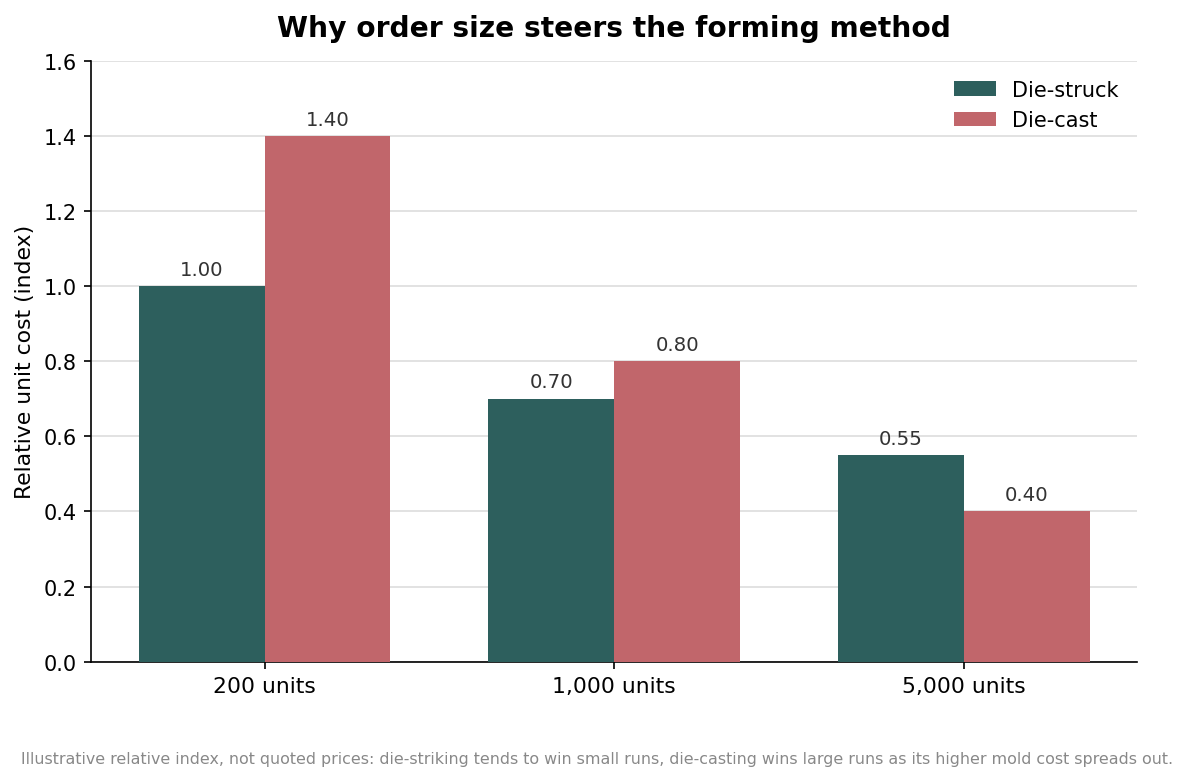
Use case tends to reinforce whatever the numbers suggest. A unit ordering a few hundred collectible coins with a sharp 2D crest is squarely in die-struck territory, and the traditional weight is part of the appeal. A company producing several thousand giveaway coins with a sculpted character, or a coin shaped like its product, will likely land on die-cast and be glad of the lower unit cost. When your run size and your artwork point at different methods, artwork should win for anything where the coin’s look is the whole reason it exists, and cost should win when the coins are functional handouts. Sort out these two questions, relief and forming method, before you fuss over plating and packaging, because they set the frame that every later choice fits inside.
Leave a Reply