The single question that derails more challenge coin orders than any other is not about art, plating, or price. It is timing. Someone needs coins in hand for a retirement ceremony, a unit deployment, a conference, or a charity gala on a fixed date, and they find out too late that a custom coin is a manufactured object with real production steps behind it. Knowing how those steps stack up lets you order with confidence instead of crossing your fingers.
The short answer, and why it has a range
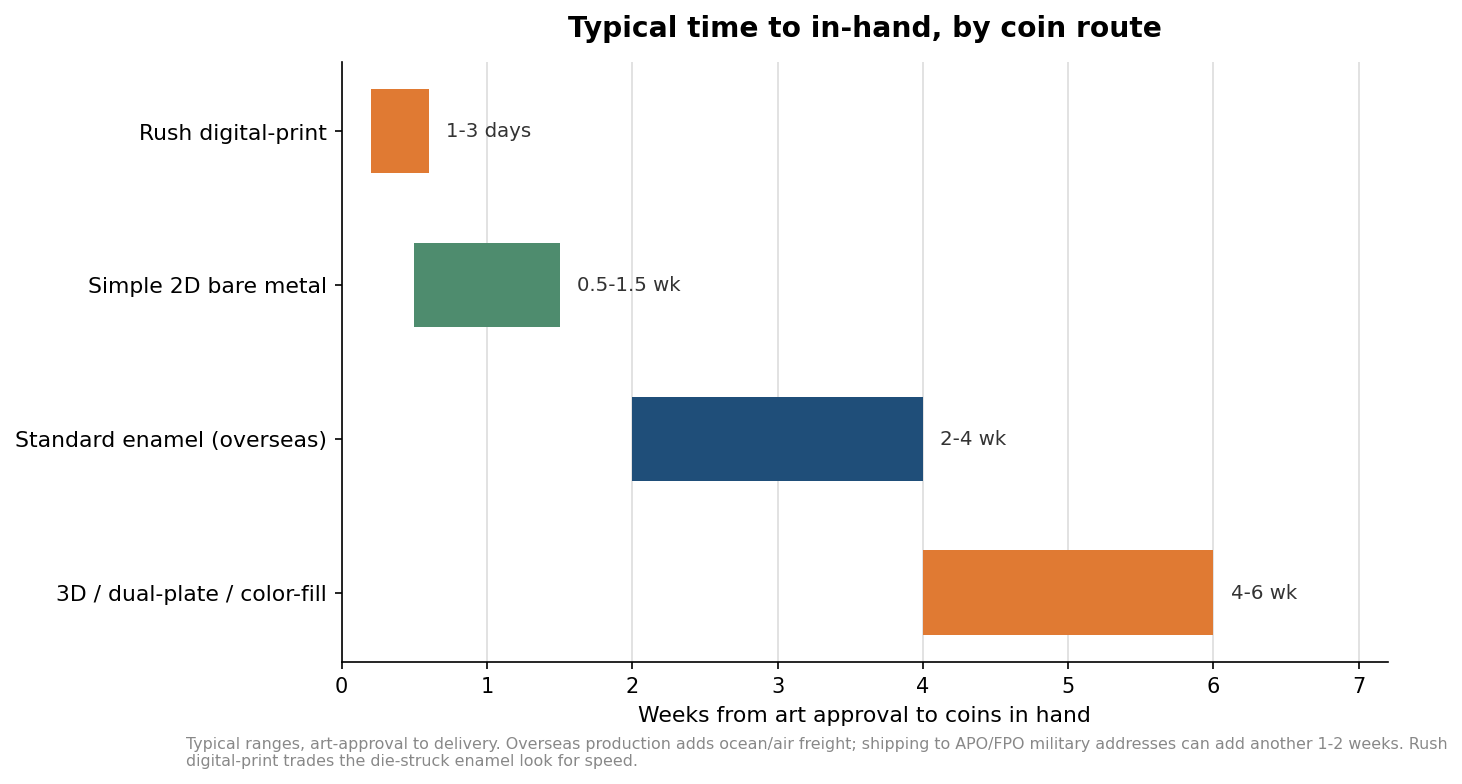
For a standard custom coin, plan on roughly two to four weeks from approved artwork to coins arriving at your door. That window covers both production and shipping for a typical die-struck, enamel-filled coin. It is a range rather than a single number because the coin you design dictates how much handwork it needs. A flat, single-color, bare-metal coin can move through production in a day or two, while a detailed 3D sculpt with dual plating and several hand-painted color areas can push the production side alone toward four to six weeks. Overseas manufacturing, which is where a large share of enamel coins are made, then adds freight on top.
Treat any quoted turnaround as starting from artwork approval, not from the moment you place the order. The clock does not begin until you have signed off on a digital proof, so a week spent trading revisions on the design is a week added to your calendar that no factory controls.
What actually happens between “approved” and “delivered”
It helps to see production as a sequence of discrete stages, each of which claims a slice of the total. After your proof is approved, artwork goes through a production quality check, often within the first day, to confirm the design can be struck cleanly at the size you chose. A die or mold is then cut, and for many shops that tooling is ready within about twenty-four hours, at which point the coins are struck from raw metal. Freshly struck coins are deburred to smooth their edges, then plated in your chosen finish, a step that commonly runs one to two days.
Color is where time quietly accumulates. Enamel or color-fill areas are applied by hand, one recessed section at a time, so a busy design with many colors takes noticeably longer than a two-tone one. Finishing, polishing, and a final inspection close out the run, typically over the last couple of days. Add it up and a mid-complexity enamel coin spends on the order of ten working days in production before it ever ships.
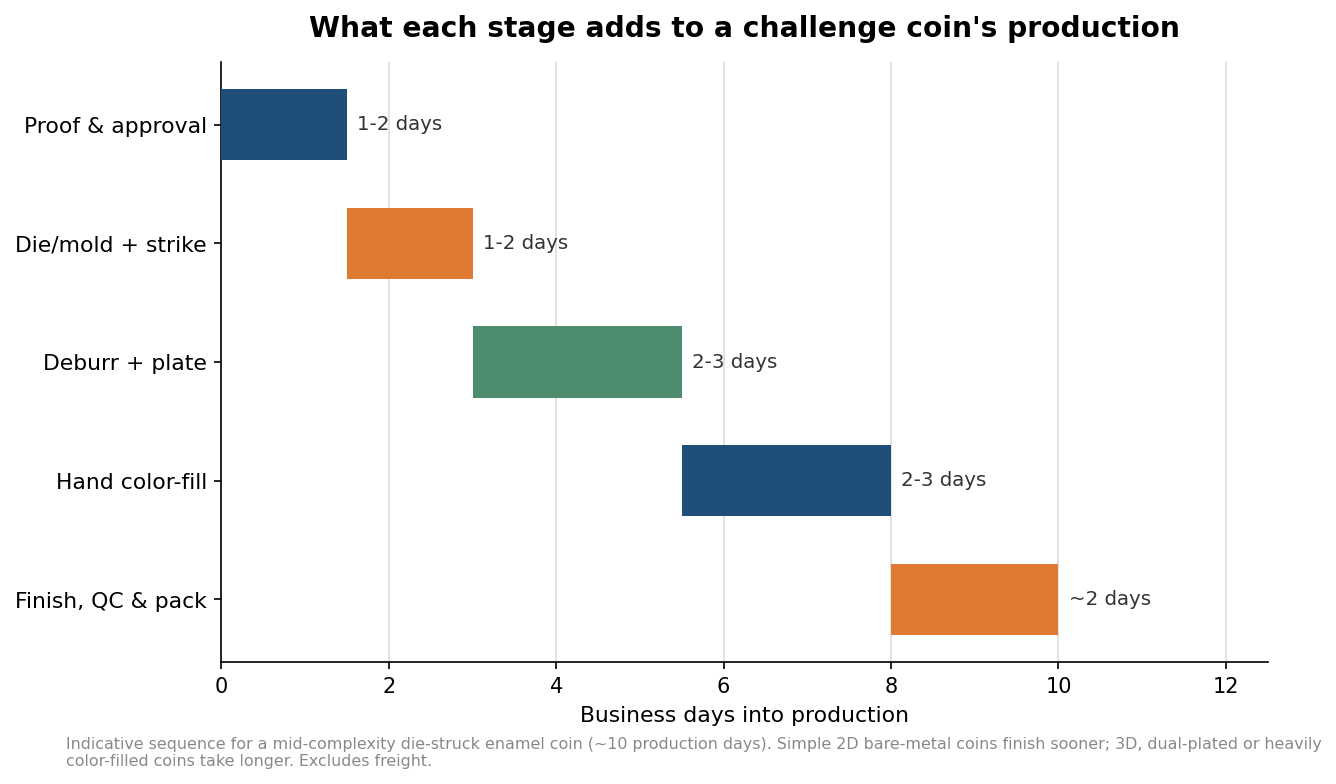
The figures above are indicative rather than a promise; every shop schedules its floor differently and a heavy queue during peak season, roughly the run-up to summer graduations and to year-end holidays, stretches all of it. But the shape holds: proofing and tooling are quick, plating and hand color-fill are the swing factors, and finishing is short.
Where the time really goes
Four variables move your timeline more than anything else. The first is design complexity, already described: 2D versus 3D, single versus dual plating, and how many color areas need hand filling. The second is quantity. Larger runs do not scale linearly, but a few thousand coins occupy the floor longer than a hundred, and very large orders may be split across production batches.
The third is proof turnaround, which is entirely in your court. Factories generally wait for written approval before cutting a die, so if the proof lands in your inbox on a Friday and you reply the following Wednesday, you have added those days to the front of the process with nothing happening in the meantime. Naming a single decision-maker who can approve art quickly is one of the cheapest ways to protect a deadline. The fourth is shipping. Coins made overseas travel by air or ocean freight, and shipments to APO and FPO military addresses can add another week or two on top of standard transit, so a coin destined for a deployed unit needs a longer runway than one shipping domestically.
When you genuinely need coins fast
Rush service exists, but it usually works by changing how the coin is made rather than simply hurrying the normal line. The fastest options print the design directly onto finished metal blanks using digital UV printing, which eliminates die cutting, plating, and enamel filling entirely. That can bring turnaround down to as little as twenty-four to seventy-two hours after art approval. The trade-off is real: a printed coin reproduces full-color and photographic art beautifully but does not have the recessed, hand-filled enamel and struck relief that give a traditional challenge coin its weight and tactile edge. If the look and feel of a classic die-struck coin matter to the recipient, rushing that specific construction is harder and more expensive than switching to a printed coin for the deadline.
The other lever is simplification. If your date is tight and you are set on a struck metal coin, dropping to a 2D design in a single plating with minimal color fill can shave days off production, because you are removing exactly the hand steps that consume the most time.
How to plan backward from your date
The reliable method is to start with the day you need coins in hand and subtract in stages. Reserve a buffer of several business days at the end for delivery and the occasional carrier delay, then account for production according to the coin you actually want, using the ranges above rather than the best case. Give the front of the schedule a few days for proofing and revisions, and if the coins ship to a military or overseas address, add a week or two more. For a standard enamel coin on a firm deadline, placing your order four to six weeks out leaves comfortable margin; for anything with 3D work or dual plating, six to eight weeks is safer.
If that math does not work for your event, you still have two honest paths: choose a rush-friendly printed coin and accept the different finish, or simplify the design to a fast-to-produce struck coin. What you want to avoid is discovering the timeline after you have fallen in love with a complex design that cannot be made in time. Decide on the deadline first, and let it guide the coin.
Leave a Reply